
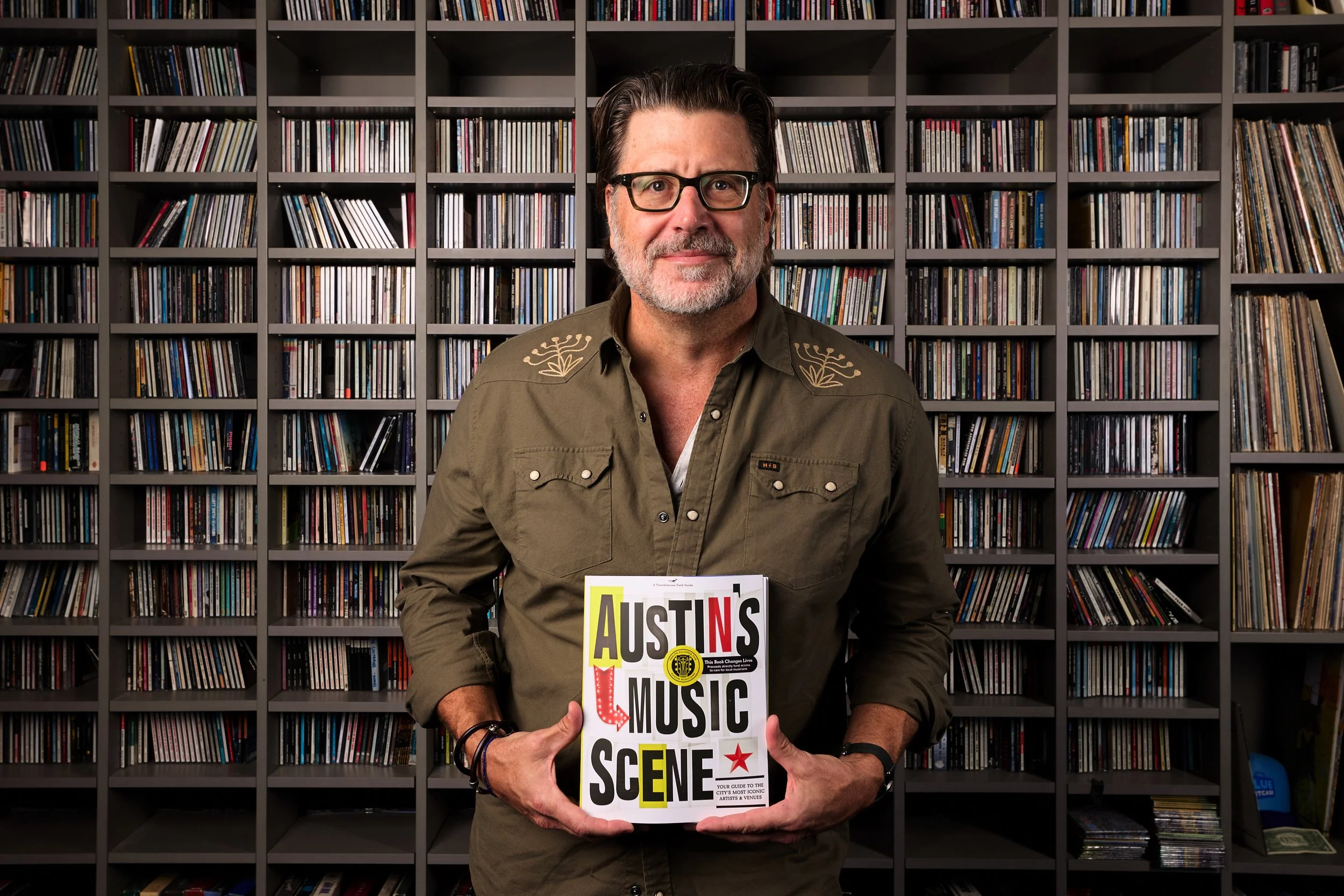
Photo by Shunya Carroll for KUTX
Five Questions for Founder and Editor in Chief Mitch Baranowski
The self-declared “recovering journalist” first discovered Austin’s music scene as an undergraduate at The University of Texas at Austin. We asked about the inspiration for this project, his approach and how his team produced it in “record time” (punny).
Why this book, why now?
A few things converged that made this feel urgent.
First, HAAM’s 20th anniversary. I was planning to launch Thunderhouse as a mission-driven media company. And when we started chatting with the Health Alliance for Austin Musicians about ways to mark their big milestone, we landed on trying to create something that both celebrated the organization but actually demonstrated why it matters. HAAM exists because Austin musicians need access to care, now more than ever. This book shows you exactly who those musicians are—their faces, their stories, their contributions to the city. It makes the mission tangible, brings it to life in a way consistent with their great programming.
Second, Austin’s music scene is at an inflection point. We’ve lost iconic venues. Rents have skyrocketed. A lot of the musicians who made this city special are getting priced out. There’s this healthy anxiety about the marketing of Austin as “Live Music Capital of the World." We wanted to put a spotlight on what’s actually happening right now. Yes, it’s harder than it used to be. Yes, we’ve lost things. But there are still hundreds of incredible artists making vital music in this city on any given night. That’s the story we wanted to tell.
Third—and this is maybe the most important part—no book like this existed. You can find books about past Austin music legends. You can find academic studies of the cosmic cowboy era or history books on the post-punk scene of the ‘90s. But if you’re visiting Austin next month and you want to know where to catch great live music beyond Sixth Street, this is for you. If you’re a local who mostly knows Willie and wants to discover the hip-hop scene or the experimental electronic community, this is for you. There was no comprehensive resource. That felt like a gap we could fill.
Plus, I figured if I’m going to forego sleeping all summer, it might as well be in service of something that matters. [laughs] Mission accomplished on both fronts.
The book profiles more than 160 artists across seven genres—what surprised you most about Austin’s music scene that you didn’t expect going into this project?
Everyone was super generous with their time and stories. Grateful for that, and expected that. Everyone was also quick to acknowledge that we’re standing on shoulders. Sue Foley talked about learning from Albert Collins. Ellis Bullard mentioned Willie Nelson and Waylon Jennings as inspirations. Kris Kimura lovingly mentioned his mentor Tony Campise, the late great tenor saxophonist.
And I knew it was a community, but I didn’t realize how it’s more like a family. These artists go out of their way to connect, collaborate and support each other. Many still work day jobs. They’re really there to get each other’s backs and cover for each other when needed.
Also, we tend to talk about Austin’s music scene as if it’s some monolithic entity, but it’s not just one scene. It’s many little scenes. And you can combine them any way you wish. There’s Cumbia Night at Hotel Vegas. Or Africa Night at Sahara Lounge. Authentic honky-tonk at the White Horse every night. The magic of Austin’s scene is it holds space for all of these great artists and great sounds.
Half of net proceeds go to HAAM, and you’re timing this with their 20th anniversary. Can you talk about why healthcare access for working musicians matters so much right now, especially with the ACA subsidy changes coming in 2026?
So here’s the brutal reality: starting in 2026, a lot of working musicians are looking at 115% increases in their health insurance premiums because ACA subsidies are potentially going away. That’s not a typo—115 percent. For people already living gig-to-gig, that’s seismic and potentially catastrophic.
HAAM has been filling this gap for 20 years, helping Austin musicians access everything from primary care to mental health services to hearing protection—which, if you’ve ever stood next to a drum kit for three hours, you know is not optional. So, the need for HAAM is only growing, and that made partnering with them to do something to help working musicians a no-brainer.
After all, these are the same musicians making Austin the stated “Live Music Capital of the World”—they’re generating millions in economic impact for the city. The least we can do is help them get the care they deserve so they can keep performing and making their art.
You’ve said you went from idea to finished book in 10 months—that’s lightspeed in publishing terms. How’d you pull it off?
[Laughs] A lot of breakfast tacos, a lot of help and some very understanding friends.
But seriously—we had to move fast because we were timing this with HAAM's 20th anniversary in 2025. We wanted this out for holiday gift-giving, a book that gives back. Traditional publishing would’ve taken 18-24 months minimum. We didn't have that luxury.
So we did everything all at once on a parallel path. We didn’t wait for text before starting design. In fact, we flipped it. Maybe this is a lesson from my advertising and marketing career—we concepted the whole book and laid it out first, designing key sections, determining what we wanted and what gaps we needed to fill. Creative director Chris Ritchie was just brilliant at every step. Editorially, we set up a separate process, using criteria to guide selecting and reaching out to artists, venue owners, festival organizers. We knew we wanted it to be a very photo-driven piece that honored artists’ voices. When we met David Brendan Hall, it felt serendipitous. He’s been a longtime journalist and photographer for The Austin Chronicle (and huge props for all they do to cover the scene). He has such a great eye and has this massive archive of images, so he graciously agreed to serve as co-curator and photo editor of the project. Accessing David’s archive was a huge time-saver, as we didn’t have to schedule too many original shoots. Plus, we were lucky to work with Jake Rabin and many other great local photographers who had wonderful images to consider.
We rounded out the team from there and just hustled, hustled, hustled at every step. We must have done 70 or so interviews to guide the content creation. So proud of our grit and determination to meet our deadline. So grateful to everyone on the team. We launched with a party on October 21 and are now in bookstores across Austin.
You’re calling this field guide the “first edition”—where do you see it going from here?
Well, the idea is to update this fairly often, every couple years—new artists, new venues, track how the scene evolves, pay tribute to legends. The scene is constantly evolving and the book should, too.
But bigger picture? I think this model could work for a few other cities. Nashville, New Orleans come to mind—places with deep music roots that deserve comprehensive, community-focused documentation. Not academic histories, but living guidebooks that actually help people experience these scenes in meaningful ways. We’d have to find the right nonprofit partners in those markets to make sure we support local artists.
Our digital companion is a big priority for us now. We've got QR codes in the book on Austin’s scene that link to curated playlists, bonus interviews, exclusive content. That allows us to keep updating even between print editions. Maybe an artist releases a new album six months after the book comes out, we can tout that, or promote something that didn’t make it into the final print edition.
For now, we’re just focused on getting the book out there and making sure every Austin musician in this first edition feels well represented, and that readers actually use the book—dog-ear the pages, spill beer on it, take it to shows. That's the whole point.
Also, I need to sleep for like three weeks straight. Then maybe we'll talk about planning a second edition.