
Spotlight on the Austin Music Scene
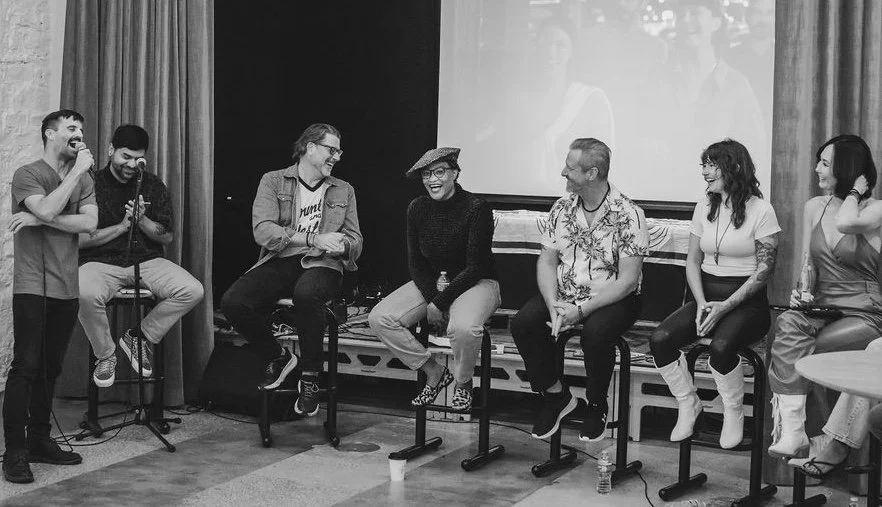
At Austin Visitor Center, five musicians discuss what it takes to keep the Live Music Capital of the World® alive and well.
The audience inside the Austin Visitor Center on Tuesday, October 21, didn’t need convincing that Austin is the “Live Music Capital of the World.” They came to hear five working musicians discuss the challenges and opportunities of the scene today.
“The challenges are real,” said singer-songwriter Taméca Jones from the panel stage, alongside R&B artist Mélat, Americana veteran Guy Forsyth, and Kelly Green and Violet Lea of rock band Madam Radar. “But what’s equally real—and what doesn’t get documented enough—is how this community shows up for each other.”
The panel discussion, moderated by Omar Lozano, Director of Music Marketing for Visit Austin, served as the centerpiece of the official launch for “Austin’s Music Scene: Your Guide to the City’s Most Iconic Artists & Venues,” a comprehensive field guide published by Thunderhouse Media Group in partnership with the Health Alliance for Austin Musicians (HAAM). Half of all net proceeds from the 224-page book will benefit HAAM’s work providing healthcare access to working musicians, DJs and music teachers.
The timing feels urgent. Austin’s music ecosystem faces mounting pressure from rising rents, venue closures and an increasingly expensive cost of living that pushes some artists to Austin-adjacent towns like Cedar Park, Lockhart and San Marcos.
The Economic Reality: “We’re All Hustlers”
Guy Forsyth, who moved to Austin in 1990 when he could “live on $10 a day,” spoke bluntly about how the landscape has shifted. “Despite having continuous work, I still wasn’t able to buy [a house] in Austin. I live in Buda now,” he said. “It’s difficult to monetize music, more so now than at any other time, because the value of music monetarily has been destroyed by the tech industry.”
He continued, “We’re all hustlers. If you’re trying to make a living in music right now, you’re a hustler. You have to be.”
Taméca Jones, Austin’s “Empress of Soul,” described how affordability challenges have “decimated” her creativity. “I’m just trying to stay afloat these days,” she said. “I just worry about money all the time.” She explained that pre-pandemic, “I could snap my finger and there’d be people in the room, and I’d make decent money for a show.” Now, after relocating to Los Angeles and returning to find a transformed Austin, she’s moving back to New Braunfels because “it’s extremely hard to make a living here and pay your bills being a musician.”
Austin’s Secret Weapon: Community Support
Yet the discussion wasn’t defined solely by the challenges. The band Madam Radar arrived in Austin in 2012 and, without a place to stay, parked their 1977 Ford Chateau in a CVS parking lot. “A woman was like, ‘Hey, you guys are staying here. Why don’t you just come stay at my house until you find a place?’ She didn’t know us,” recalled Kelly Green, guitarist/vocalist. “That’s just Austin, in a nutshell. People want to help, and they love to support artists, and the community here is like no place else I’ve ever been.”
Violet Lea, Green’s bandmate on bass/vocals, pointed to HAAM as a turning point in feeling legitimate: “When I got my HAAM membership, I was like, I’m a real musician now. And now I need to do real musician things, because I got to keep this membership.”
Mélat, born in Austin, spoke about persistence in finding her place in a town better known for country, blues and rock. “It took a while for me to feel like I was accepted into the Austin music scene. I felt like I was making this R&B and soul music that no one really understood.” But she kept playing her music and eventually felt heard. “I do feel at home here,” she said.
The book emerged from ten months of intensive work documenting Austin’s contemporary music landscape. Editor-in-Chief Mitch Baranowski, a fourth-generation Texan who first moved to Austin in 1987 for journalism school, assembled a team to conduct exclusive interviews with dozens of artists across seven genres: Country/Americana, Rock/Indie, Blues/Soul, Hip-Hop/R&B, Jazz, Latin/World and Electronic/Experimental.
“When we started this project, people asked: ‘Why a book about Austin music now?’” Baranowski told the crowd in his opening remarks. “That question itself is the answer. Because right now—in 2025, not 1975 or 1995—Austin’s music scene is more diverse, more resilient, and more vital than it’s ever been. But that story isn’t being told comprehensively.”
While several books chronicle Austin’s musical history—from the cosmic cowboys of the 1970s to the grunge explosion along Red River Street in the 1990s—no comprehensive guide has captured the breadth of what’s happening today. The field guide addresses that gap by focusing on active artists and venues while honoring the legacy that shaped them.
The book features profiles ranging from local legends like Patty Griffin, Gary Clark Jr. and Spoon to emerging voices like Die Spitz, Next of Kin and Urban Heat. It spotlights more than 50 venues—from historic landmarks like the Continental Club and Antone’s—to hidden gems like the Sahara Lounge and Little Longhorn. It includes hand-drawn venue maps, festival listings, historical sidebars on foundational figures like Doug Sahm and W.C. Clark, and QR codes linking to bonus content.
Paul Scott, HAAM’s CEO, emphasized that the book serves a dual purpose as both love letter and support system. “For 20 years, HAAM has worked to ensure that the musicians who define Austin have access to healthcare,” Scott said. “This guidebook does something equally important—it documents and celebrates their artistry while generating resources to support their wellbeing. Every purchase directly helps the artists profiled in these pages.”
Looking Forward with Hope
Despite economic pressures, the panel ended on notes of resilience and creativity. Kelly Green cited School of Rock as a source of inspiration: “I saw all of these young kids from the ages of 4 to 16 with instruments playing songs, and that gives me hope.”
Taméca Jones said she draws support from Black female entrepreneurs, but also cited the nonprofit Diversity Awareness and Wellness in Action (DAWA), started by Jonathan 'Chaka' Mahone of Riders Against the Storm. “They have put on so much for the community, and he is a lifeline,” she said.
Guy Forsyth mentioned the ethos that keeps artists creating music despite challenges: “I am inspired by my friends in the music business, who’ve been doing it so long, constantly coming back to reinvent themselves in ways that are helping the community. Musicians are empaths, they are interested in other people. Otherwise you wouldn’t do it.”
“Austin music is not a sound. It’s a scene,” the late Michael Corcoran wrote in his survey of Austin’s first 100 years. This new field guide extends that observation, documenting how the scene has multiplied into countless micro-scenes: the punk shows at Hotel Vegas, the Africa Nights at Sahara Lounge, the honky-tonk residencies at the White Horse, the jazz jams at the Elephant Room. “My scene is not your scene,” Baranowski writes in the book’s introduction. “And that’s what makes it so special.”
Featuring sections on artists, venues and festivals, along with a dedicated “Visitor’s Guide” packed with insider tips, the book is perfect for both longtime Austin residents discovering local talent and first-time visitors planning their live music experience. This is the first edition, with future updates planned to keep it current.
ABOUT THE BOOK
Title: “Austin’s Music Scene: Your Guide to the City’s Most Iconic Artists & Venues”
Publisher: Thunderhouse Media
Pages: 224 (full-color throughout)
Price: $40
Available: thunderhouse.co, select retailers like Book People, Waterloo Records and Whole Earth Provision Co. and (soon) Amazon
Highlights:
● 160+ artist profiles with exclusive interviews
● 50+ venue spotlights (Austin proper and destination venues)
● 30+ festivals profiled
● Hand-drawn neighborhood maps
● Historical sidebars on foundational figures
● Impact section on supporting Austin’s music nonprofits
Purpose: Half of all net proceeds benefit the Health Alliance for Austin Musicians