
Austin City Limits: “It’s about the music.”
A Conversation with Executive Producer Terry Lickona
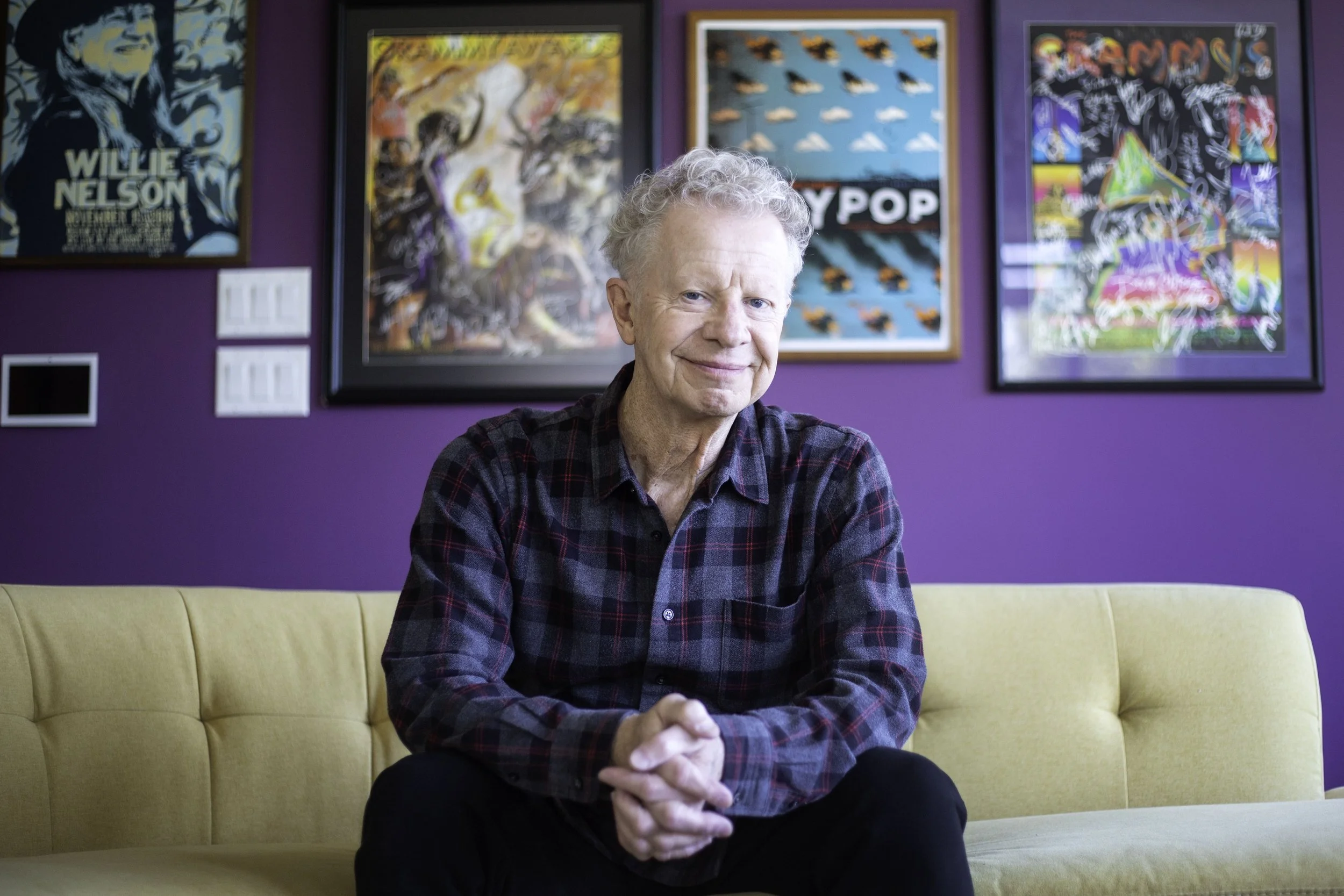
Courtesy Austin PBS
Terry Lickona has helmed “Austin City Limits” since 1978, making him one of the longest-running executive producers in television history. In 2024, he received the Beacon Award from PBS, the highest honor in public television, joining the ranks of Mister Rogers, Gwen Ifill and Ken Burns. In our extended chat, he reflects on guiding the iconic program through five decades of music history.
You came to Austin for Willie Nelson’s 1974 Fourth of July picnic and never left. How did you go from radio DJ to television producer?
I’m from Poughkeepsie, New York, and went to college in upstate New York, in Albany, but I always had an interest in radio. I got involved in the college radio station, which led to a part-time job at the local Poughkeepsie radio station that became full-time. In my 20s, I just wanted to get out in the world and see what it’d be like to live someplace else besides Poughkeepsie, New York. I came to Austin on a road trip with a friend for Willie’s Fourth of July picnic in 1974, fell in love with the place, and moved here about four or five months later.
My first job was at KUT, which was in the same building as KLRU, the PBS station. My timing was uncanny—I literally moved to Austin about two weeks after they taped the original Willie Nelson pilot show. “Austin City Limits” hadn’t even aired, so I didn’t really know what that was all about. But I got to meet the producers of the show, asked if I could learn the ropes and maybe help out and volunteer, and within three years, I was the producer. So that’s a very condensed version of my life story—starting out as a radio DJ with no experience whatsoever—to becoming a television producer.
That’s 48 years now—possibly the longest-running gig in show business. What did receiving the Beacon Award mean to you?
I didn’t believe it at the time. The Beacon Award has gone to people like Mister Rogers and Ken Burns, and they’ve also given it to programs—I think a couple of years before, “Frontline” was the recipient. So when Paula Kerger from PBS first told me they wanted to present it to me, my first response was, why don’t you give it to “Austin City Limits”? There’s a whole team of people who’ve been working with me for decades to make the show what it is today, and I didn’t quite feel right being singled out. But that’s what they wanted to do, and of course I was very happy to receive it. It really represents more than just me, because I couldn’t have done what we’ve done together as a team alone.
If I have one strongest suit, it’s that I’ve hired the best people to do what they do and then let them do their thing—whether it’s Gary [Menotti], our long-time director, or the people who do the lighting, the audio, the producing team. These are people who really are the best in the business, bar none.
You’ve witnessed five decades of change in Austin. How has the music scene evolved since you arrived?
Oh, my God. Where to begin? Nothing stays the same. “Austin City Limits” has grown from a Texas country music program to a show that represents every type of music, every genre, as long as it’s good, original music that deserves an hour of our time. As for Austin, everything is constantly changing—the food scene, the tech scene, the film scene. I’m not one of these naysayers who complain that Austin’s not as good as it used to be. Yes, it’s five times bigger than when I moved here—it was about 200,000 [people], and it just felt like a big college town with a very lively music scene because it was something for the college kids to do on a Friday or Saturday night.
But I still get to know a lot of musicians—some who are known, some completely unknown—who have that same fire in their belly and creative passion they had in the 1970s. I have friends in their 20s who have to work two or three jobs, share the rent with roommates, and play a gig maybe just for the door or for tips or for no money at all, just for the chance to be on a stage and prove to themselves they have something to offer.
Austin has always been kind of an incubator for new talent, compared to Nashville or New York or LA. We have no real industry here to speak of other than some mom-and-pop record labels and people who’ve tried to set up shop, but it’s still a great place to hook up with other musicians, put a band together, try to write some music, and make things happen without feeling the same kind of pressure you would in a company town. We’ve gone through cycles—from cosmic cowboy to punk to blues and rock and folk and Americana—and all of that still exists in one way or another in Austin today.
The show’s title suggests boundaries, but you give artists complete creative freedom. How did that philosophy emerge?
That was by design. The format has not really changed from the beginning. The whole idea was to build a stage and invite an artist to come in and do their show, the show they do night after night on the road. That’s entirely up to them. We don’t approve a playlist. Artists can play what they want and bring whoever they want. We even give them the right to pick the songs that make the final cut for PBS. We’ve always given artists that artistic freedom, and we’ve always made the quality of the sound our number one priority.
We’ve upgraded production values—we used to have three cameras and white lights that just flipped on. Now we have sophisticated lighting and more cameras, still not as many as they have at the Grammys. But it’s still the same in heart and soul. The artists get it. They know it’s a bucket-list item. Doing “Austin City Limits” isn’t like doing “Saturday Night Live,” as great as that is, or a song or two on a late-night show.
We’ve survived against all odds. Nothing lasts forever—that includes businesses, marriages, partnerships, you name it. We thought maybe the pandemic might be the thing that finally did us in, but we struggled through and were able to record seven shows in our venue without a studio audience at all. Our supporters—the companies, the underwriters, the people who’ve backed us over the years—hung in there with us even during those hard times.
That’s one thing I hope hasn’t changed about Austin. As much as it’s grown, I think a lot of the people who move here do so because there is that sense of shared community—people care about their institutions, about keeping Austin unique and weird and different. And we’ve had that kind of support consistently down through the years, despite all the ups and downs.
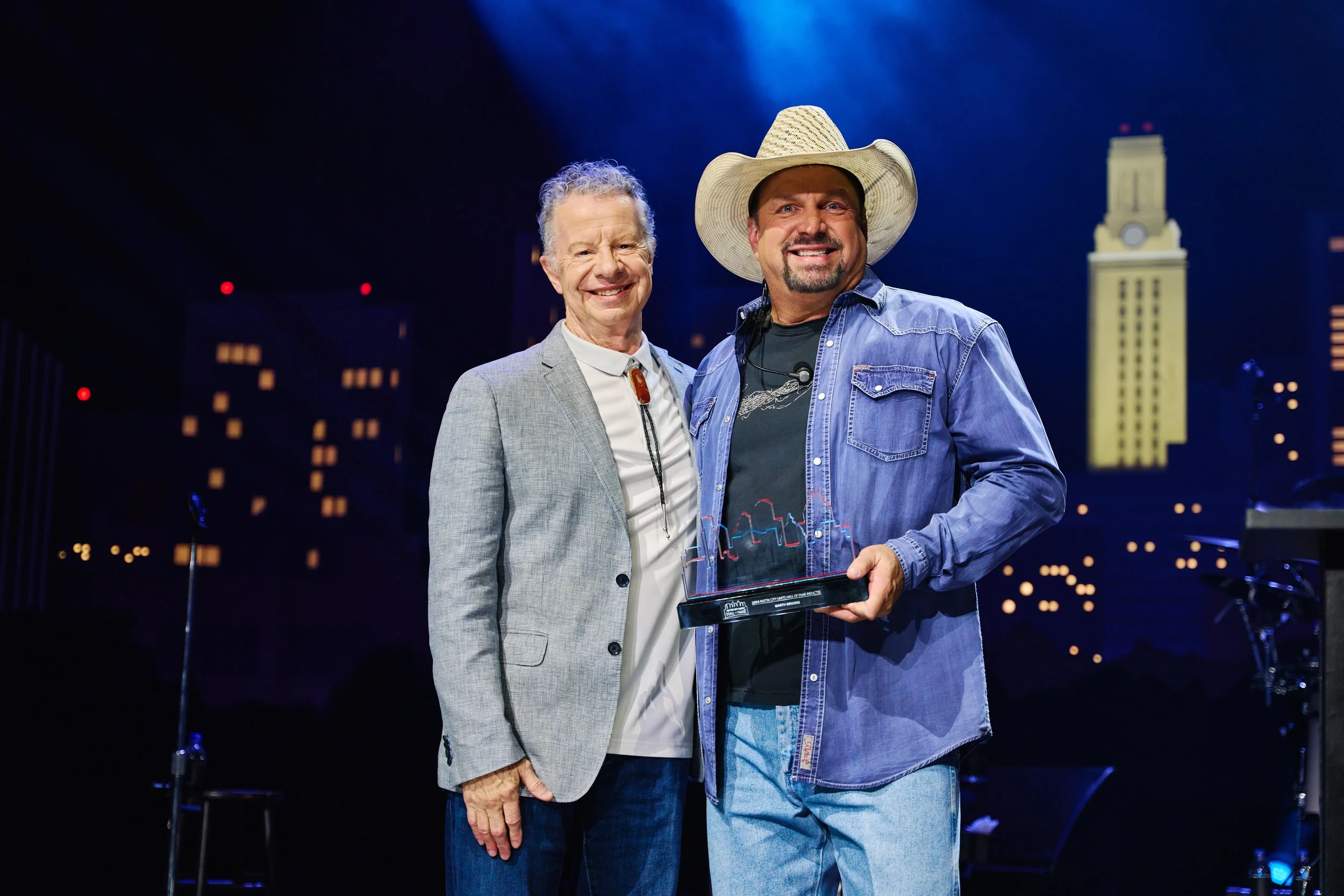
With Garth Brooks. Courtesy Austin PBS.
The Austin skyline backdrop has become the show’s signature look. How did that iconic design come about?
In the first couple of years, we had audience bleachers behind the stage so that it was kind of in the round. We gave up on that idea because the artists didn’t feel too comfortable having a bunch of people behind them staring at the backs of their heads—and the people sitting back there didn’t really enjoy that view, either. So we tried a couple of other ideas, until the light bulb went off—it’s called “Austin City Limits,” let’s have the city as the backdrop for the show.
Once that became established, the artists get it. They know they’re coming here to tape “Austin City Limits.” That has been our signature look for so long that nobody wants to mess with it. They’re willing to leave all of their production gear and video screens and special effects in the truck, because they know our show is just about the music.
There have been exceptions. We did a show with St. Vincent a few years ago, and she had a big video wall on her tour, so we compromised—she used half a video wall below the skyline so it didn’t mess with the view. Coldplay had this huge production wall, like a graffiti wall lit in all colors, so they played most of the show with our skyline and then lowered their special backdrop for the last two songs. And with Tom Waits, we did make it rain—we had somebody with a bucket of confetti sitting in one of the lighting grids over the stage, and when the time came, he just started tossing it out so it looked like rain. But it’s never really an issue. Artists don’t want it to look like some other show that wouldn’t be recognizable as “Austin City Limits.”
The show has clearly inspired generations of musicians. Can you describe the impact you’ve seen firsthand?
Our show’s been around long enough now that I think we’re on our third generation of artists who’ve done the show. Our most recent taping was with Finneas—Billie Eilish’s brother, of course. He and his sister had done the show back in 2019, and when he came back last week, he said that when they were kids growing up, they would watch “Austin City Limits” on their parents’ little TV in the kitchen while their parents were cooking or washing the dishes. You can’t really put a value on the impact that something like this has had for so many years.
People have been inspired to pursue music, or to explore genres they weren’t familiar with, or discovered new artists. Discovery is really one of the big parts about the show and has been from the beginning. Flaco Jiménez just died recently, and I still remember when he did the show—it was the first season of “ACL,” before I became producer. Back then there was no email, but they were getting mail from Vermont and places all over the country—people blown away by this guy from Texas playing an accordion in a way they had never heard or imagined.
The most recent comment I loved was from My Morning Jacket’s drummer. We did a show with them because they were inducted into our Hall of Fame, and he said that growing up, they didn’t have cable, and “Austin City Limits” was one of the few things they could watch on PBS. He said, ‘It was like having a music venue in your home.’ I’d never quite thought of it that way, but it’s true. It’s not somebody doing one song, one and done. Artists get a chance to stretch out and include songs they don’t normally get to do on TV. We’re going to use that tagline a lot.
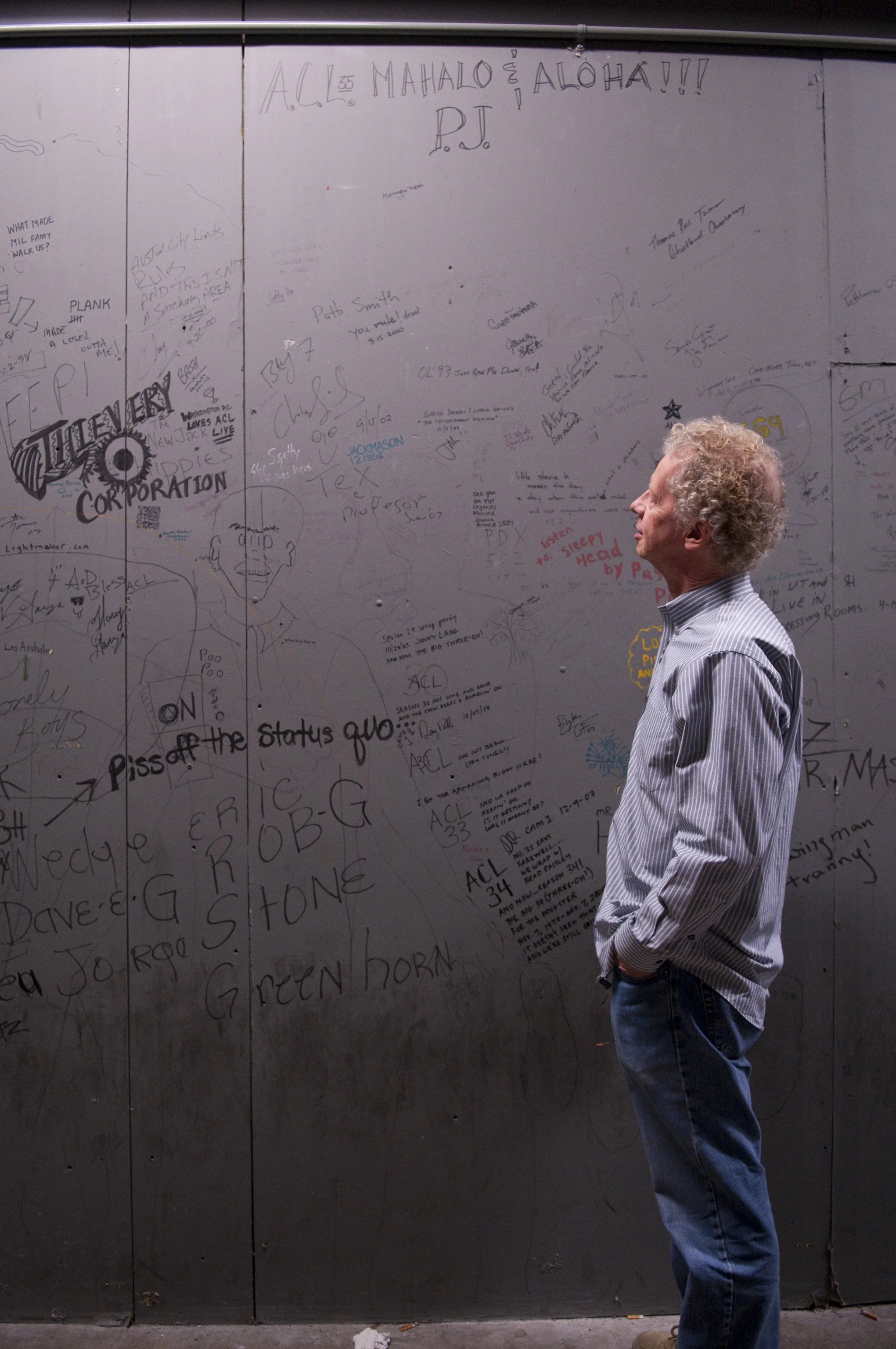
The signature wall, backstage at “Austin City Limits.” Courtesy Austin PBS.
You’ve personally booked over a thousand shows. How do you think about the art of booking?
Nobody with PBS, and no one with Austin PBS, has ever told me who I should book or not book, which is almost too good to be true. We hit a thousand shows about a year and a half ago, so we’re probably up to 1,200 or so now. Booking is the most important and most fun thing that I do. I’d be lying if I said I’ve batted a thousand all these years—I’ve certainly learned a lot, especially about timing. There’s an art to booking an artist at the right moment. Too soon or too late is not ideal. It’s better when they’ve really become who they are, when they’ve reached a certain level of their artistry, and it’s kind of obvious that now is the time to capture them on our stage.
As we expanded into different genres, we wanted to do hip-hop years ago when it really caught fire, but part of the challenge with PBS was finding a hip-hop act who could keep it clean enough without us having to bleep every other word. But we got there. We had De La Soul, and we had Kendrick Lamar—probably one of my favorite shows of all. He got it right away. Kendrick hit the stage and it was almost like he flipped a switch in his head—he just substituted clean words for the ones that would have been a problem for PBS, and nobody could tell the difference.
We introduced Latin music beyond just Tex-Mex or conjunto and started booking Latin artists from all over South America, Spain, you name it, especially as Latin music became so hot. We’ve even had the Austin Symphony on. I never felt like we had to compromise or book an artist or a kind of music that just didn’t feel right. You won’t find a certain kind of Nashville–Las Vegas country-pop sound on our show—I’m not a fan of that, and I don’t think our audience is either. But who knows? We haven’t had any K-pop on the show yet, either.
How are the current funding cuts affecting the show?
It’s kind of hard to explain to people, but it’s not going to hurt us directly. “Austin City Limits” is a part of Austin PBS—that’s how the show began, and it still is. Austin PBS never sold the show to Live Nation or some other entity. But the Austin PBS station, like every other PBS and NPR station in the country, is definitely feeling the pain. It affects Austin PBS by about ten percent of their total annual budget. We’re lucky to be in Austin, where the economy is strong and we have the support of the people here, but in smaller markets—Midland, Lubbock, Corpus Christi—it’s really hard on those stations to fill that gap and stay on the air.
We do have our own underwriters—they’re essentially sponsors, although they don’t get to do a full-blown commercial like on commercial TV. The money from our underwriters pays for the baseline production costs. But Austin PBS provides so much production and staff support that we couldn’t do it on our own. There’s nobody who works at the Austin PBS station who doesn’t have something to do with “Austin City Limits,” whether it’s part of the crew or the accounting department or marketing or engineering. We’re all part of the same family, so any significant cuts that affect Austin PBS will affect us.
We may have to tighten our belts and cut some corners, but we are committed to continuing to do business just like we have for all of these years. We’re not going to cut back on the number of programs or anything else that would compromise the integrity of the show. That’s our vow.
As you celebrate 50 years and look toward the future, what’s your vision for the next chapter?
Most of the shows we’ve taped in season 51 represent a newer generation—artists like Finneas, the Marías, and 25-year-old jazz singer Samara Joy, who has one of the most incredible voices on the planet. She’s a jazz singer in the same vein as Ella Fitzgerald, in my mind, and she’s 25 years old. If we can get Doechii to do a show—and she’s here at ACL Fest—that will be one for the books, I can guarantee.
Beyond booking the next generation, we’re exploring new platforms. We’ve started live streaming our tapings when artists allow it, creating a whole other kind of event. Instead of taping in July and airing in October, we can throw it out to the world on our YouTube channel so anyone, literally anywhere in the world, can watch live as it’s happening. That’s a fun thing—feeling like you’re getting a sneak peek behind the scenes.
You’ve amassed an incredible archive. What’s your dream for preserving this musical legacy?
We’ve got 50 years of incredible, historic performances—so many artists who are no longer with us. Everything has been digitized, not just the edited programs you see on PBS, but all of the original recordings—B.B. King’s whole performance, the Foo Fighters’ whole two-and-a-half-hour performance—and the soundtracks, the multi-track recordings as well. The actual videotapes from those early shows are in a salt mine in Kansas. Don’t ask me where exactly—that’s what I’m told. But tapes don’t last forever, and some of those had begun to deteriorate.
My dream is to be able to offer all of the archives to the world—for people to stream a song or a whole show, or download it. Clearing the rights and sorting through all of that is more than I have the time for, but there are people who do that. In today’s world, where you can access just about anything online, it would be great if people who are real music fans, who are curious, who may want to discover something from a show we did in 1985, will have the ability and opportunity to do that. That’s a personal goal and dream of mine, and I hope we get there someday.
After nearly five decades at the helm, how are you preparing the next generation to carry on the show’s legacy?
As you can probably tell, I still love what I do. I could talk all day about it. As long as my health holds up, I don’t really have any desire to hang it up and walk away. But I’ve brought new blood on board—in the last two years alone, I hired two new members of my producer team, ages 29 and 39. It was the first time we’d had any additions to the team in 25 or so years. Frankly, not because we were reluctant—we just didn’t have the budget. The 50th anniversary opened things up a little, plus producing a show is more complicated than it used to be.
I think it comes down to two things: creating this legacy—this body of work we’ve built over 50 years—and bringing new people on board who can learn from what we do. Which, after all, is how I learned. I was brave enough to go up to the producers of the show back when it was a brand-new thing. They were all 10 to 15 years older than me, and they taught me the basics. I hope I can do the same—teach others to learn from us, not just from me, but from the rest of the team.
I wouldn’t say that “Tiny Desk” got their idea or inspiration from us, but maybe it has something to do with being a sister music program on NPR. Either way, the fact that shows like that exist, that others can mimic what we’ve done in their own way—that’s part of the legacy, too.