Happy birthday, Ray.
The fearless leader of Asleep at the Wheel is still riding high after 50+ years in the Lone Star State.
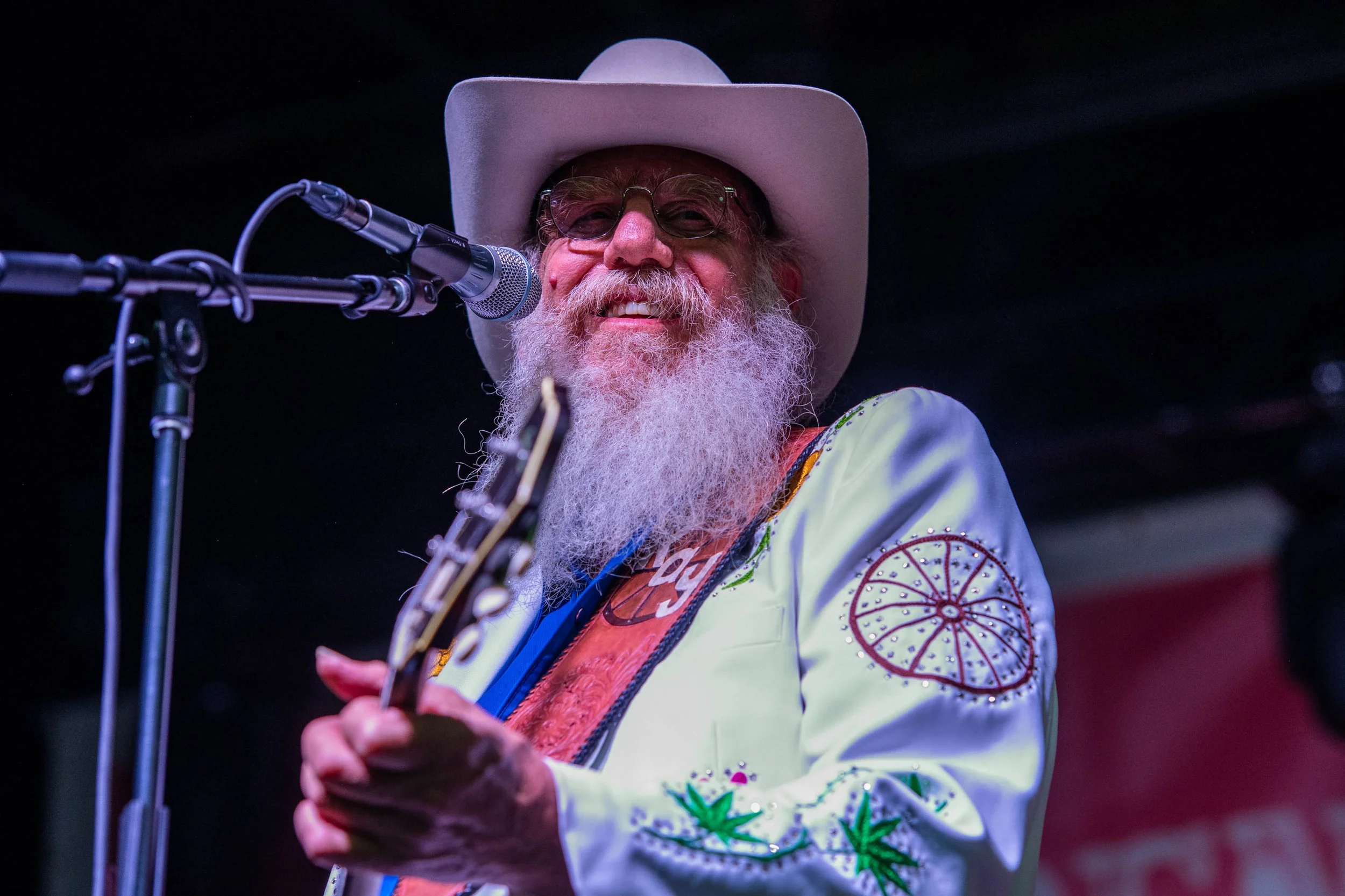
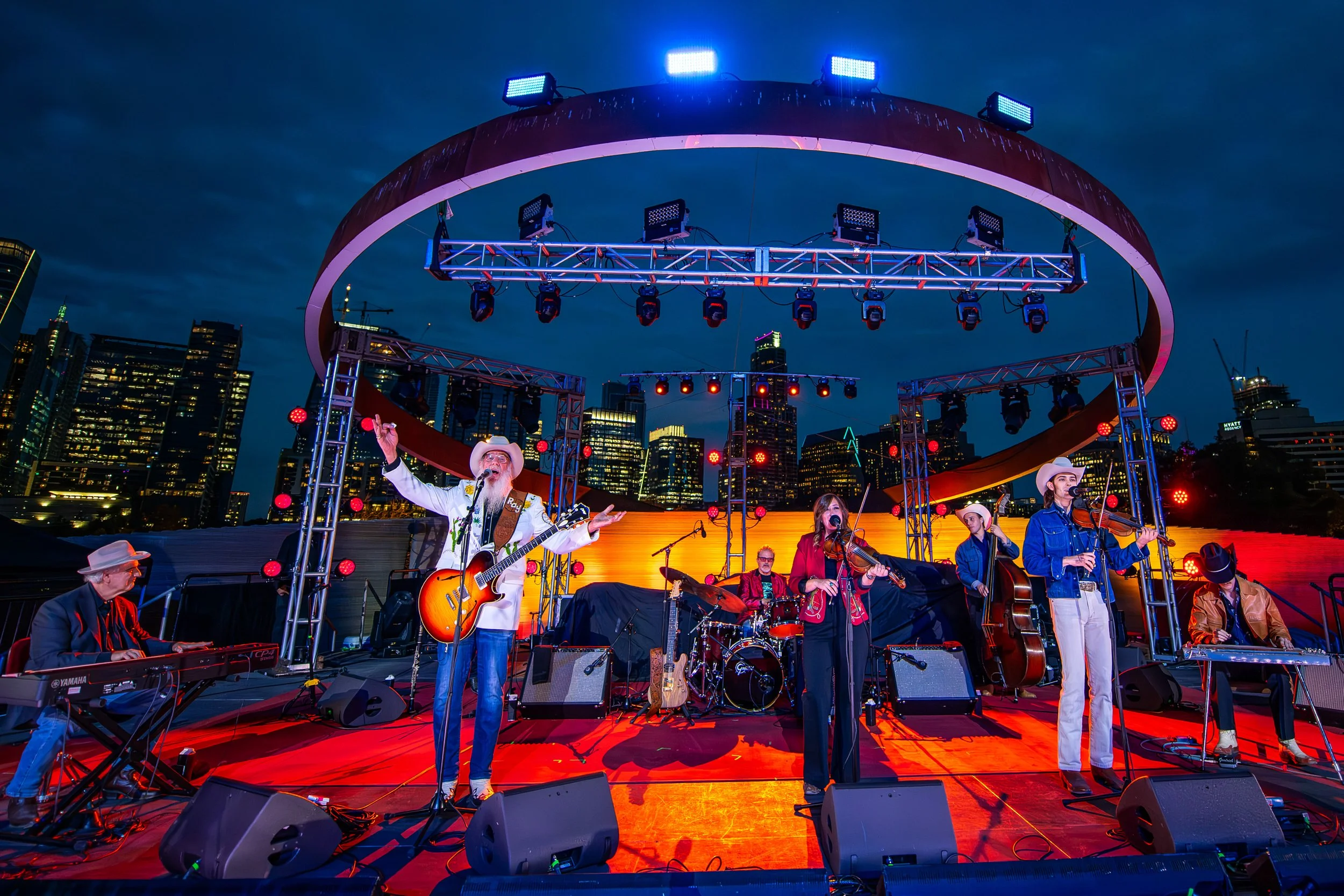
Photos by David Brendan Hall.
Ray Benson has been the steady heartbeat of Asleep at the Wheel since 1970, making him one of the most enduring figures in American music. Here in our extended interview he reflects on the band’s journey, his musical upbringing, his advice for younger musicians and Austin’s music scene today.
Let’s start at the beginning. How did you first get into music?
When I was about nine, my sister had been taking guitar lessons, and I picked up her four-string guitar and just started playing. I listened to the Philadelphia Phillies baseball game, and they had a beer commercial, and I picked it out on the guitar. My parents said, “Oh, wow.” So they started giving me lessons.
We formed a little group—me, my sister, a kid down the street and another girl. Called ourselves the Four G’s. From the Sears catalog, we got square dance outfits for the girls and matching denim for the boys. Folk music was big in ’60, ’61, ’62, and we played all over the place. In 1962, we played with the Philadelphia Orchestra. We sang “This Land Is Your Land” and “On Top of Old Smokey.” I was like, this is what we do. This is great.
My parents just thought it was like Little League, you know. Oh, this is their hobby. But I just got the bug.
And you had a pretty serious music education beyond that?
Through high school they gave me music lessons. I took up the bass fiddle, and then they said, “Hey, you don’t play a fall sport. Why don’t you play tuba? We need you in the marching band.” So I played tuba, and I was in the orchestra, the band, everything. We were in what they called the stage band, and we played swing music—Benny Goodman, Count Basie. So I got a really good education in older music. It was always reaching back.
Was there a moment where you knew older music was going to be your thing?
My cousin gave us a wire recorder—this was the predecessor to the tape recorder, about 1957 or ’58. Horrible quality, but it was this little piece of wire that [you] recorded on. And he had recorded Big Bill Broonzy doing “Stagger Lee.” I remember thinking to myself, “I’m going to learn this song and play it.” I didn’t even play guitar yet. But that impulse—hear an old song, learn it, play it—that’s been the whole career, really.
You’ve always said Asleep at the Wheel is a live band. How important were places like Texas dance halls in your development?
We cut our teeth doing that. You can’t fake it when you’re standing up there and the crowd is looking at you. When we came here in late 1972, early ’73, there were about 1,000 dance halls. We weren’t from Texas, so we had to learn fast. One time we’re playing the Farmer’s Daughter in San Antonio, and there’s a six-foot-high [cutout] picture of Bob Wills behind the stage. The crowd asked for “Cotton-Eyed Joe.” Now, I had a record of Bob Wills doing it, but he sings it. So we started it, and I’m singing [like Bob], and no one is moving on the dance floor. They’re waiting for us to kick into the Al Dean version—instrumental, no vocals. They walked out disgusted. That’s how we learned.
We had to learn all the dance hall traditions. People would say, “Play a Paul Jones,” and we’d say, “What’s that?” [It’s a traditional mixer dance.] We came with great love for Texas music, but we had to earn the right to play it.
There’s a difference between playing a dance hall and playing a concert hall. How do you think about that?
A dance hall is a dance hall. A concert hall is a concert hall. You’ve got to adjust to either one, and that’s the deal—or you’re relegated to just one, and that’s fine too. As a band, as a performer, you’ve got to adjust.
What was it about Western swing that connected with you so much?
We started out to be a country-western band. Western meant Bob Wills. Chris and Danny came in with “Right or Wrong,” and I went, “Oh, this is great. This has got the lyrics of country music, but it’s got the swing feel and enables us to jam on the guitar.” When we put out our first record, we were still living in California but coming down to play in Texas, and all of a sudden it was like, “Holy shit. People are going ape over the fact that we’re playing western swing like Bob Wills.” We didn’t realize that in Texas, Oklahoma and California, Bob Wills was as big as Elvis back in the 1940s.
EDITOR’S NOTE: Chris O'Connell was vocalist/guitarist with the band from the early '70s through 1986. Danny Levin was an early member of The Wheel, first on piano then fiddle and mandolin.
You’ve been the glue for the Wheel for 55-plus years. What has kept you motivated all these years?
I love performing. I just love to stand on stage and sing and play. That’s the bottom line. I’m so privileged. I still sit on that bus and I love staring out the window at this incredible place called America. You just have to have that wanderlust.
After that much time on the road, how do you think about your audience?
Every 10 years or so, you’ve got a whole other crowd to add to your audience. It’s a generational thing. You’ve got to have hit records if you want a 55-year career. But the live show is what keeps it going.
You and Willie and others helped create the current Austin scene. What’s changed? What’s stayed the same?
Everything’s changed, except for the music. The music that comes out of people’s creativity—that hasn’t changed. But everything else? Oh, gosh. Where should I start. Cell phones. When we used to go on the road in 1973, you went with a pocket full of quarters so you could make phone calls from pay phones. One of the biggest things, even before cell phones, was a fax machine. Oh my God, you can plug this into the phone and you’re gonna get paper over the phone. And then a mobile phone was revolutionary.
It was like joining the Foreign Legion. You’d get in the bus and you’re gone. And the interstate highway system was not nearly what it is today. They didn’t have the loops around town yet in most places. So you’d go right through the center of town. Just totally different.
Looking ahead, do you think live performance becomes more important or less?
As we go into the future with AI and everything, I think it’ll become even more important and desired to have live performances. Because you can’t fake it when you’re standing up there and the crowd is looking at you.
The move out west, your first record deal, meeting Willie in Dallas then playing the ‘Dillo—it happened fast in those early years, didn’t it?
It was lightning. Here’s the wonderful thing about youth—I expected it. But no, it was ridiculous.
EDITOR’S NOTE: Before Austin, the Wheel had been living in Oakland, where they'd landed after Commander Cody invited them out west. A mention by Van Morrison in Rolling Stone helped them get a record deal with United Artists. Then Willie Nelson saw these long-haired kids playing Bob Wills music, got curious, and told them to come to Texas. They played the Armadillo World Headquarters in 1973 and moved to Austin for good in February 1974.
Are there lessons from your early days you share with younger musicians?
We had one tape of us playing the Sportsman’s Club in Paw Paw, West Virginia, in 1970. We were so bad. The musicianship was horrible. But we practiced every day. We were starving in West Virginia. We went down to get food stamps one day, and the guy said, “Where do y’all work?” We said, “We’re musicians.” “How much you get paid?” “We don’t get paid anything. We’re trying to get jobs.” He shook his head and gave us $100 in food stamps and told us not to come back.
I keep telling young musicians this: You’re going to have to sacrifice. If you have a full-time job, that means you can’t be on-call. But at some point, someone might offer you a gig up in Oklahoma City that pays $300. Get in your car and go up there and spend $100 on gas. That’s the kind of dedication you really have to have.
Do you still enjoy Austin’s music scene?
Oh yeah, it’s an incredible town. I bemoan a lot of what has been happening, but then some entrepreneur will come along and open up a little dance hall. You still have a lot of choice in Austin.
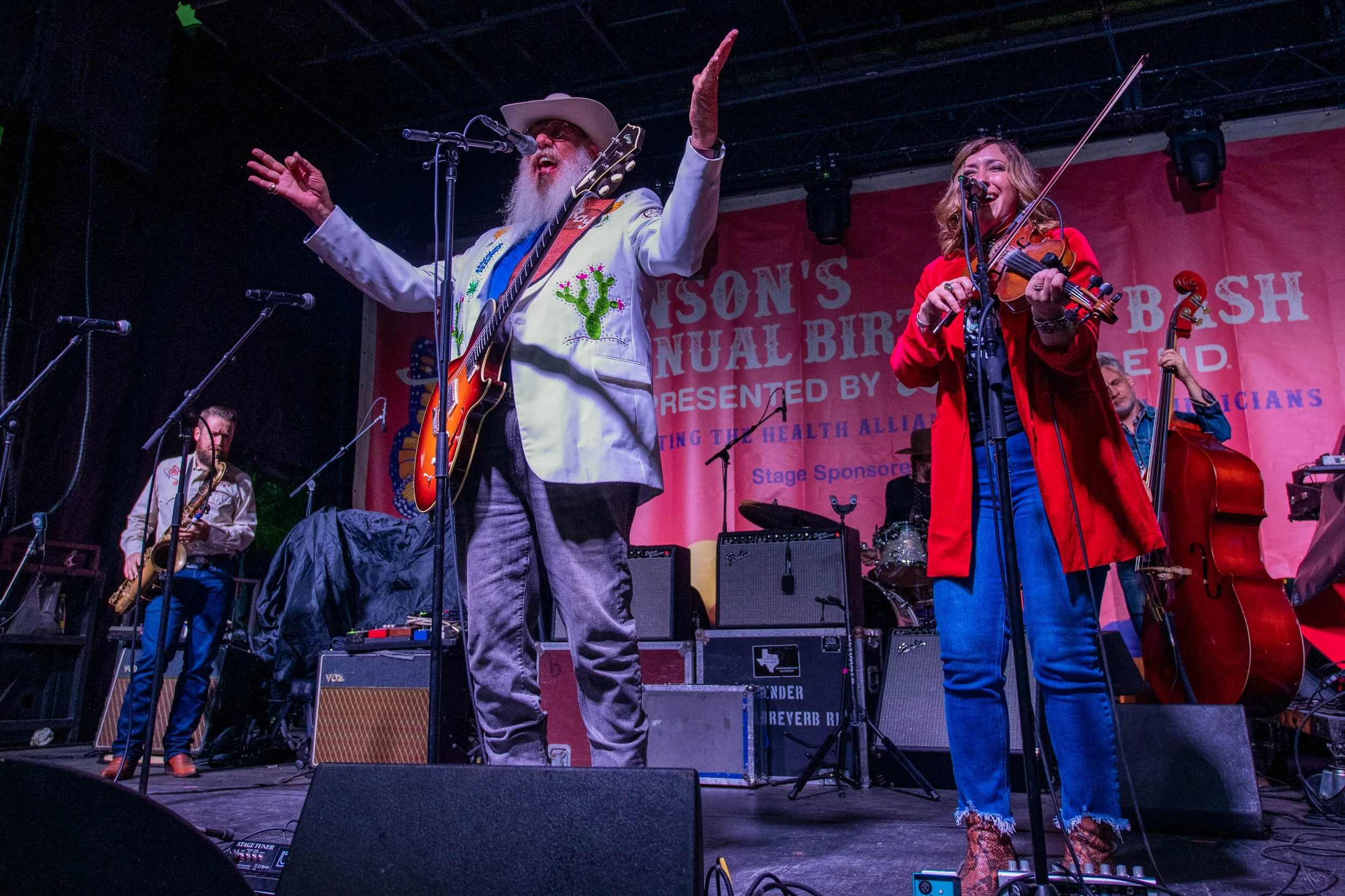
ASLEEP AT THE WHEEL: AT A GLANCE
ESTABLISHED: 1970
GENRE: Western Swing
SITE: https://www.asleepatthewheel.com/
INFLUENCES: Bob Wills, Milton Brown, Spade Cooley, Benny Goodman, Count Basie, Big Bill Broonzy
KEY VENUES: Various festivals, Gruene Hall, Broken Spoke
ESSENTIAL TRACKS: “Take Me Back to Tulsa,” “The Letter (That Johnny Walker Read),” “Riding High in Texas”
FUN FACT: Ray Benson stands 6'7" and has kept Asleep at the Wheel going through more than 100 different band members.