
With “Brasileirôu,” Frederico7 Finds His Way Home, One Song at a Time
On his most personal album yet, the singer-songwriter turns two decades of exploration, grief and joy into a love letter to Brazil, Austin and himself. Catch him at Brazil Day ATX on Sept. 5.
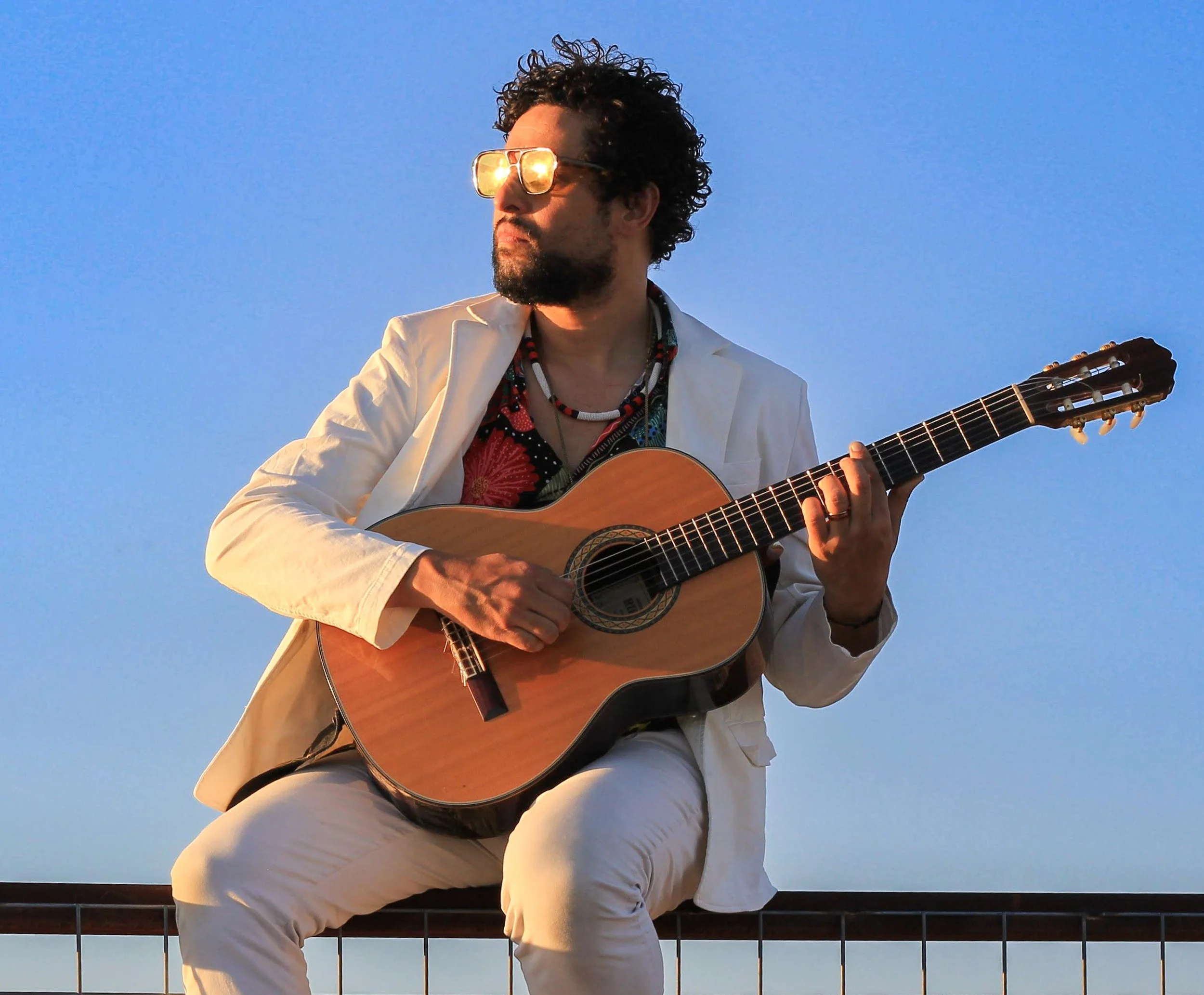
Frederico Forte—the artist known simply as Frederico7—has spent more than two decades building a bridge between Brazil and Austin, one song at a time. His new album, Brasileirôu, is his most personal crossing yet: a 12-track meditation on resilience, joy and the parts of home we carry inside us no matter where we land.
Working with longtime producer Beto Martinez and bringing in arranger Pedro Dom, the record pulses with rhythm and depth, folding in grief over his late mother, tenderness for his daughters, and his lifelong appreciation for The Cure.
We caught up with Frederico7 ahead of his September 5 set at Brazil Day ATX to talk about how the album came together and what it really means to get “Brazilianized.”
You’ve been in Austin since the mid-’90s. How do you think about your journey here?
I like to think of it as two chapters. I arrived for college in the mid-’90s, and Austin’s streets were my music school. I followed the scene closely, and in the early 2000s some friends and I started a band called Ghandaia. We did some really cool things at a time when there was a huge boom in Latin and world music across town. We played ACL when Grupo Fantasma was also being born, and we did several shows together. Ghandaia had a special thing: we mixed reggae with Cuban and Brazilian music, all with a funk outlook. In 2006 I took a break from Austin for family. So that was Chapter One—I was a student of music, starting my first band, always standing on the shoulders of giants.
Chapter Two started when I came back around 2009 or 2010, after a couple of years living in Mexico. I started playing with drummer Michael Longoria. Among friends, I like to say I attended the “Michael Longoria School of Music.” I learned so much from him. Even though I’d always been a songwriter at heart, it wasn’t until 2017 or 2018 that I said, okay, this is Frederico7, I’m going to own it. We put out our first album, Exótico Americano, in 2019, and now, finally, the second one is out.
Where does the name Frederico7 come from?
A couple of places. There’s the biblical read: seven is the number of completion. Seven days to complete creation, seven colors in the rainbow, etc. When I step on stage, I feel completed. Every part of my brain lights up, your full being has to be alert, and it begets a kind of joy. That’s the central idea. The more mundane reason: when I was a kid playing sports in Brazil, my coach gave me the number seven, and it stuck. That was always my number on my soccer team.
How do you translate the new album’s title?
Brasileirôu. It’s a play on words—like a verb, to get Brazilianized. I’ve been observing what’s happening in the world right now—so much division, so much hyperbolic talk—and I started thinking about skills Brazilian people have developed out of a lack of resources: creativity to overcome scarcity, resiliency, the idea that you can resist through joy. Brazil has the biggest carnival and party in the world, and when people think “party,” they often think Brazilians, but that contrasts against a very difficult economic life and a country with a deep history of social injustice. Somehow Brazilians wake up each day and say, this sucks, but we’re going to overcome it with joy as irreverence. It’s universal, too. I think about Dolly Parton, who showed us that same joy out of a hard place. It’s not exclusive to Brazil; it’s just the musical vocabulary that’s most accessible to me.
I was in Brazil two years ago with my wife—it had been a long time since I’d been there—and I got to visit my elders and my family. That’s when the idea crystallized: I’m seeing how I’ve been Brazilianized by being home, but it’s also about looking at myself as an immigrant in Texas. A lot of the skills that have let me keep making music here after all these years—the resiliency, the choosing of a little joy even when life is tough—those are skills I learned from my elders in Brazil. So Brasileirôu is both external, about the world, and internal—who am I after 25 years in the Austin music scene? How do I keep connecting Austin and Brazil? At the end of the day, the album is a portal between Austin and the Brazil that’s inside of me.
How does this album build on, or move past, Exótico Americano?
Exótico Americano had a thesis about the immigrant experience—questions about where I fit, and how the world interacts with that. The biggest difference with Brasileirôu is that I’m coming back home to myself. Some of that comes from the pandemic, when we all had to reassess what matters. And around my age, many of us are losing our parents—I lost my mom during this process, and that sends you on a journey of meaning and identity.
Musically, I wanted this to be an honest portrayal of what I can do with my guitar, what my voice sounds like, where I am right now—nothing flashy for the sake of showcasing. I went into the studio for one weekend with percussionist Luiz Coutinho, a master of Brazilian and West African rhythms who’s lived in Austin for about 30 years. It was just my nylon guitar, my vocals and his percussion. We recorded 10 of the 12 songs that weekend, without a metronome click, on purpose—we wanted to capture that raw energy. Some of my vocals are a little raw too, because sometimes I was crying in the booth. Some of these songs are about moments with my daughters, or hard parts of my own trajectory. It’s honest. I wasn’t trying to mask the edges.
Who else shaped the sound?
We recorded just outside Austin with Beto Martinez at Lechehouse Music. I’ve known Beto since my first chapter in Austin, when Grupo Fantasma was just starting. We worked together on Exótico Americano in 2019, so I feel completely comfortable in that room.
Then Michael Hale came in on drums. He brought American funk and jazz, but in a way that has a real conversation with Brazilian percussion. Same with the woodwinds. It’s jazz, but it’s Brazilian jazz; sometimes the saxophone lines were written rhythmically as if for a hand percussion instrument. And a huge development for this album was Pedro Dom, an arranger, composer and conductor from Brazil who lives in L.A. now and has scored several Brazilian films. I met him at SXSW, showed him the ten songs I’d cut with Luiz, and asked if he’d arrange them. There’s a tradition of Brazilian songwriters working with arrangers, going back to Caetano Veloso and others. When you hear the violins, the woodwinds, the horns—that’s Pedro’s response. I told him, “Dude, you read my soul.” The first song on the album starts with just my guitar and a violin line he wrote, and it brings this cinematic quality to the whole record.
Was there a song where the arrangement changed a lot from what you first imagined?
A couple come to mind. “Learning to Live Without You” is almost like a story with two narrators—me as the protagonist, and Pedro’s arrangement acting like an observer watching the story unfold. There’s a real juxtaposition of soft and hard sections that shouldn’t work together, but they do.
The other is the one cover on the album—“A Forest” by The Cure. That song takes me back to being 16, in my first “band,” learning it in a friend’s garage. I brought it back on this record almost by accident—I was playing some bossa nova chords one day and just started singing the melody on top. When Pedro arranged it, he brought an eeriness and a nuance I wasn’t expecting at all.
The album has almost no electric guitar or synth. Was that intentional?
[laughs] In this land of electric guitar, how dare I, right? I love electric guitar, I love synth—I’ll probably make an album with them someday. But except for one song, there’s none of that here. The exception is “Chamego,” which is kind of rock-and-roll meets Brazilian northeastern folk. I wrote it wanting a texture I knew my friend Evan Marley has. We’d jammed for years but never really worked together. When that song came together, I finally had my excuse. He came to the studio, brought tacos and donuts for everybody, and we had a great day.
Honestly, saying “no electric guitar, no synth” out loud sounds like a silly rule, because I’m at the service of the music. Some of these songs came from dreams. There’s a graceful mystery to making music, and if I make too bold a statement about what I won’t do, I might be limiting myself to that mystery. Also — shoutout to my bass player, Alán Uribe, who I’ve played with for decades. The bass line on the first song, “O Infinito É Logo Ali,” was so new and jarring to me the first time I heard it that I didn’t like it. Now I can’t unhear it. He makes that song.
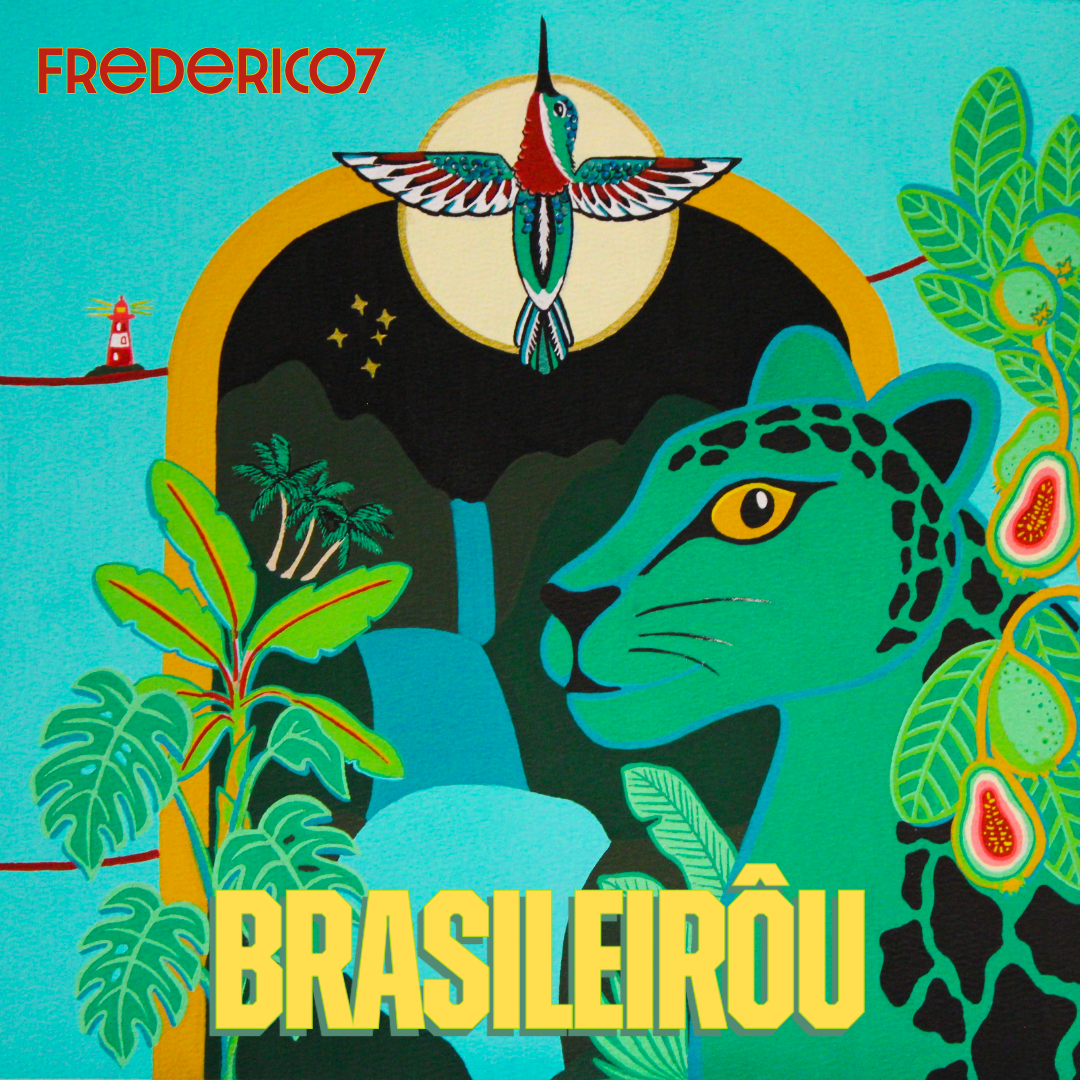
Family is clearly a huge presence on this record — starting with the dedication.
The artwork is by my wife, Vivienne Forte. We like to say we’ve substituted the word “marriage” for “work”—we’re on parallel paths, doing the work together. We lost our mothers exactly six months apart, hers and mine. When it came time to translate this album into a visual world, I’d already been watching her paint for three or four years as a way of processing her own grief. I told her, you’re making the artwork for my next album, and you have complete freedom. She nailed it! She created these portals, and now that word is part of my own vocabulary for the album. Every element in the artwork ties back to a lyric. There’s a lighthouse because I mention one in song 12. There’s a boat because there’s a canoe in song 11. There are guavas because of the song “A Goiabeira”—The Guava Tree.
My mom is a huge part of this, too. I was born in 1975; she was 22, a single mom in São Paulo during the military dictatorship. She was endlessly curious—she learned German and English—and she gave me the world before I even understood what that meant. While making this album, I found audio tapes of her talking about her life, and I’ve been writing and journaling about her ever since.
And then there are my daughters, Odara and Antonella. There’s a song called “Antonella”—she turns 17 on September 14, so happy birthday to all the Virgos out there. It’s just a father opening his heart to his daughter.
“Learning to Live Without You” carries a lot of weight. What’s really behind it?
It’s about several things—losing my mom, first of all. She passed while I was writing this song. And if I go a little deeper: my mom was diagnosed with schizophrenia and paranoid delirium around the year 2000, though looking back, some of those patterns were probably there when I was a kid, too. I’m married to a psychotherapist, so I’ve become comfortable talking about this, and part of what I try to do with my music is reduce the stigma around mental health, because it touches families so deeply. These are universal themes—someone in almost every family has dealt with something like this. It’s been part of the difficulty I’ve had to work through, and part of what it’s meant to try to be a musician in Austin.
Austin is rare in that it has organizations like SIMS Foundation and HAAM, great resources for artists and their health.
Big shoutout to SIMS and HAAM, and to any organization jumping into the arena to do good work for musicians. When I first got here, a lot of those organizations existed, but I didn’t always know they were for me, or how to advocate for what I needed—maybe because I was younger, maybe because I was an immigrant and didn’t know the landscape yet. Over the last 15 years, as the city has grown, those organizations have grown, too. So my message to other artists—especially immigrant artists, or anyone new to town—is simple: if you or someone you love is struggling, there are services, and there’s a welcoming community here for you.
You often move between English, Portuguese and Spanish, sometimes in the same song. How do you decide?
This album has nine songs in Portuguese—or eight and a half. “Chamego” is mostly in Portuguese with an early-’60s Memphis rock-and-roll feel, but the last verse switches to Spanish. A lot of my songs start as a little movie playing in my head, and those scenes get colored by my own life. In that case, I lived in different parts of Mexico for about five years, and there’s a memory in there—I mention a Mayan goddess at the end of that song. It wasn’t a conscious decision in the moment. I let the music be the guide—maybe I have a phrase and a melody, I sit with the guitar, find the chords, and loop it for twenty minutes until the next phrase comes. Sometimes whole verses in Spanish show up that way. English has a certain beauty I can’t always get in Portuguese, and vice versa.
Tell me about the album release show at The Rosette.
It sold out, which always feels good. It was immersive—I made video poetry for each song, so there were projections, an 11-piece band with backing vocalists. I wanted people to feel like they were stepping inside the world of the album, so we built a whole world around it: an open bar with guava drinks, Brazilian finger foods, and DJ Tropicana Joe, who has this incredible collection of vintage Brazilian music. When people bought a ticket, I wanted them to get a taste of Brazil right here in Austin, even if they can’t afford a plane ticket there. It was really special.
What’s next for you?
I’m playing Brazil Day ATX on September 5, and I’ve got Fiesta Festival later this month. Beyond that, I’m working hard to put a tour together — that’s really what’s at the end of the rainbow for me. If people want to help, come find me on Bandcamp, sign up for my newsletter, and if you book shows, come talk to me.
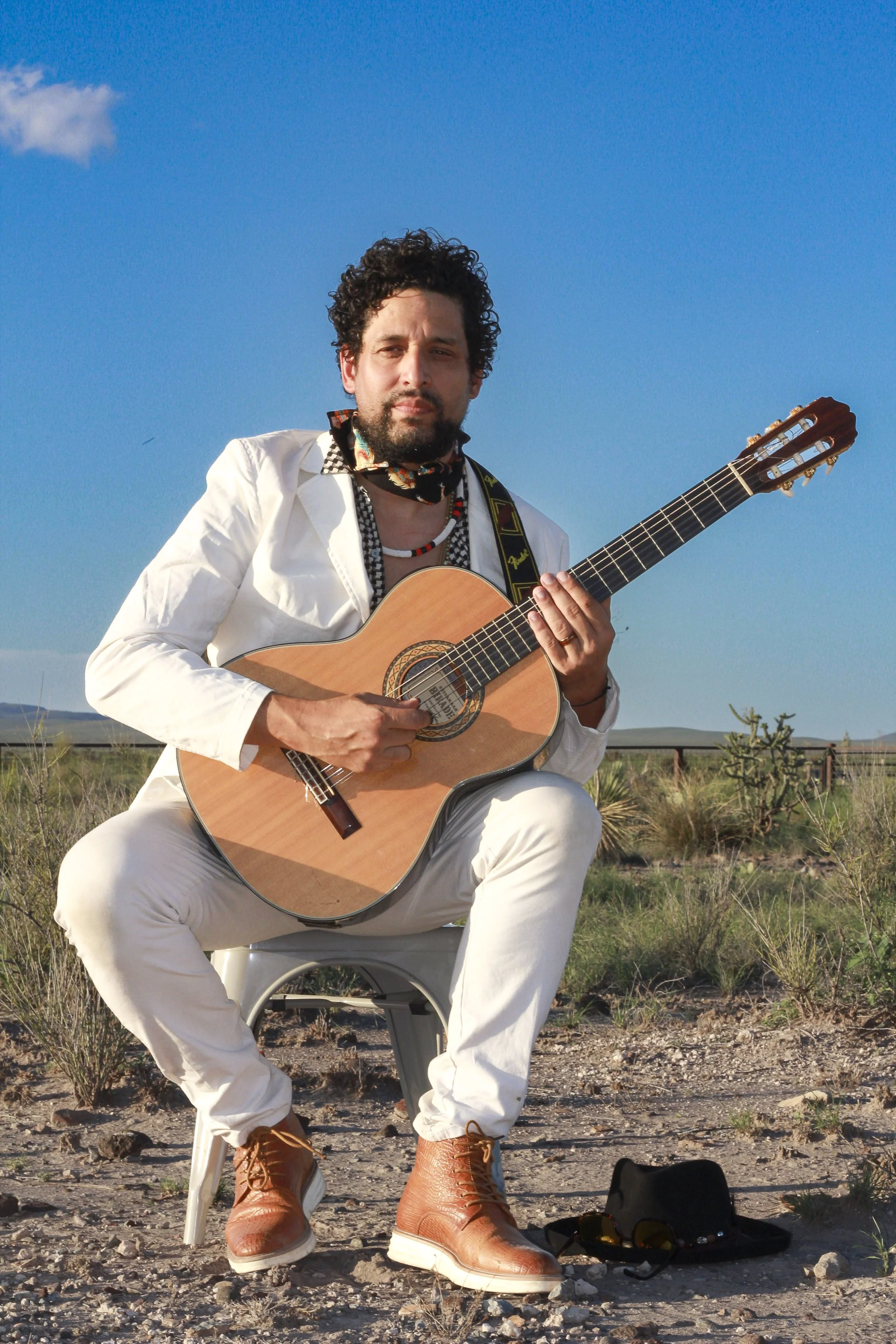
Catch Frederico7 on Sept. 5
Frederico7 performs Saturday, September 5, around 6:30 p.m. as part of Brazil Day ATX, held at Radio/East in Austin.
The event runs 5:00 p.m. to midnight and marks Brazilian Independence Day weekend—a night of live music, food and community celebrating Brazilian culture in Austin.
